
Moving From Texas to Colorado in 2026: The Real Numbers
Quick answer: Texas is now the largest source of new Colorado residents, about 27,600 a year, and Colorado still posted a net loss of 24,200 people that same year. Texas has no state income tax but an effective property tax rate near 1.40%. Colorado charges a 4.40% flat income tax with an effective property tax rate near 0.50%. On a $600,000 home, Colorado costs you less in state taxes until your household taxable income passes roughly $123,000 (source: Tax Foundation, 2026 State Tax Competitiveness Index). But the tax math is the easy part of this move. The part that decides whether you are happy here is the life, and almost nobody writes about that honestly.
More people move to Colorado from Texas than from any other state in the country. If you have been thinking about it, you are not doing something unusual. You are making the most common interstate move in America right now.
I am a Realtor in Longmont, and most of the people I work with are 800 to 1,000 miles away when we start talking. Texas is where most of them come from. So let me tell you what I actually tell them, in the order it actually matters.
If you would rather watch it, I walked through all of this on camera, including the parts that are easier to show than to write.
Why are so many Texans looking at Colorado?
Almost nobody says "taxes" first.
What they say first is some version of the same thing: it is too hot, and we are tired of being stuck inside.
I worked with a couple from Frisco who put it exactly that way. What pulled them was the rugged beauty, the dry air, and the chance to be outside instead of hiding from the weather 5 months a year. The spreadsheet came later. The feeling came first.
If that is where you are right now, you are in the normal place. You are not being impulsive. You are noticing that the shape of your week is being decided by the weather, and you want it back.
That said, the feeling is what gets you looking. The numbers are what make it work. So let's do both, and let's do the numbers first, because financial clarity is what turns a daydream into a plan.
Is Colorado still filling up?
No. Colorado had a net loss of 24,200 residents and ranked 45th in the country for state to state migration.
That single fact undoes most of what you have read. The "you better hurry, Colorado is exploding" story is a 2021 story. It is not the 2026 market.
Homes are sitting longer. Sellers are negotiating again. You get inspections, repairs, concessions, and time to think. That is a very different market than the one in your head, and it should change how you plan this.

Here is the part that surprises people most. The number one place Coloradans move to is Texas, about 23,000 a year. The 2 states are trading populations almost evenly, and both sides are convinced they are getting the better end of the deal.
Is Texas or Colorado cheaper?
It depends entirely on your numbers, and most people compare the 2 states wrong, because they only compare the half that favors the state they are standing in right now.
Here is the whole bill.
| Texas | Colorado | |
|---|---|---|
| State income tax | None | 4.40% flat |
| Effective property tax rate, owner occupied | 1.40% | 0.50% |
| Average combined sales tax | 8.19% | 7.89% |
Source: Tax Foundation, 2026 State Tax Competitiveness Index.

Texas has no income tax. Texas also charges roughly 2.8 times Colorado's property tax rate. Those 2 facts pull in opposite directions, and which one wins depends on how much house you own relative to how much you earn.
The rule of thumb: the more house you own relative to what you earn, the better Colorado looks.
Run it on a $600,000 home and it gets concrete fast. In Texas that is about $8,400 a year in property tax and nothing in income tax. In Colorado that is about $3,000 in property tax, plus 4.40% of your taxable income. The 2 lines cross at roughly $123,000 of household taxable income.
Under that number, Colorado costs you less. Over it, Texas does.

That is why the same move saves one family money and costs their neighbors money. Texas usually still wins if you are a high earner in a modest house. Colorado often wins if you are house rich with a moderate income. Retired. Self employed with lower taxable income. Or trading up in home value without trading up in salary. Colorado also does not tax Social Security, and there are senior property tax exemptions.
Worth knowing: Colorado property taxes did go up in 2026 when pandemic era relief expired. I broke down exactly what changed and why here: Colorado's 2026 Property Tax Hike, Explained. Even after that increase, Colorado's average effective rate is about 0.49% against a national average near 0.90%.
I am a Realtor, not a CPA. This is a framework for thinking about the move, not tax advice, and it leaves out deductions, exemptions and credits that will change your number. Run it with your accountant.
How do I actually run my own numbers?
Take 2 minutes and fill in 4 lines using the house you are actually looking at and the income you actually have.
- Home value. What you would pay in each state.
- Property tax. Home value times 0.0140 in Texas. Home value times 0.0050 in Colorado.
- Household taxable income.
- State income tax. Zero in Texas. Income times 0.044 in Colorado.
Add lines 2 and 4 for each state. That total is the only version of this comparison that matters, because it is yours.
If you want it as a worksheet with the blanks already laid out, it is page 3 of my free Texas to Colorado guide.
What actually changes about daily life?
This is the section I wish somebody had written for my clients before they got here, because the money question has a calculator and this one does not.
The air is different, and you will feel it for about a month. Longmont sits right around 5,000 feet. You will be thirstier than you expect, your skin and lips will let you know about it, and the first few weeks of exercise will feel harder than they should. Then it passes and you stop noticing. Sunscreen matters more here than it did in Texas, and that catches people off guard because it does not feel as hot.
You get your summer back. That is the trade people feel the most. Colorado summers are warm in the afternoon and then the temperature drops in the evening, so the back half of the day is usable. Patios, trails, kids outside after dinner. If your Texas summer routine is a run from one air conditioned box to the next from June through September, that is the specific thing you are buying back.
A lot of homes here do not have central air, and that is not a defect. Older Front Range homes often run evaporative coolers or nothing at all, because for most of the year you open a window at night and that is the whole system. Coming from Texas that reads like a red flag on a listing. It usually is not. Ask about it, price it if you want it, but do not throw out a good house over it.
Winter is not what you are picturing. You are picturing Chicago. The Front Range gets snow, and then the sun comes out and a lot of it is gone in a day or 2. It is a dry cold, and dry cold at 30 degrees feels different than wet cold at 40. What actually gets people is not the snow. It is that the sun sets before 5 in December.
Your yard is going to look different, and you are going to have feelings about it. This is the one nobody warns Texans about. Northern Colorado is semi arid. The default landscape is not a thick green lawn, it is rock, native grasses and drought tolerant planting, and water restrictions are a normal part of summer. The upside is that the yard costs less to run and takes less of your Saturday. The adjustment is real anyway. If a green lawn is part of what home looks like to you, know that going in.
Hail is the weather event you have to take seriously. Not tornadoes, not hurricanes. Hail. It is the reason Colorado homeowners insurance is priced the way it is, and the reason your policy's wind and hail deductible deserves an actual read before you close, not a skim. That deductible is often a percentage of the home value rather than a flat dollar amount, which is a different animal than what most people carry in Texas. Talk to an insurance agent early, not at the closing table.
The bugs mostly go away. Small thing, enormous quality of life difference. Summer evenings outside without getting eaten alive is a genuine perk nobody puts in the brochure.
Everything is smaller and closer. Longmont, Loveland, Berthoud and Fort Collins are not Dallas or Houston. The grocery run is 8 minutes. You will run into the same people at the same coffee shop. If you are coming from a metro where a 40 minute drive is normal and unremarkable, the compression is the best part of the trade for some people and claustrophobic for others. Be honest with yourself about which one you are.
The mountains are close but they are not next door. From Longmont you are looking at them all day, and you are still twenty minutes from being in them, and on a Saturday in summer, everybody else on the Front Range had the same idea. People who move here and thrive are the ones who build the outdoors into a normal Tuesday, not just a big Saturday production.
What will I miss about Texas?
I am not going to pretend the answer is nothing.
The food. Real Tex-Mex and real Texas barbecue do not travel, and Colorado has not solved it. You will find good places. You will not find your places. Plan on a cooler in the car on your first few trips back.
How cheap it was to run your life. No income tax shows up in every paycheck, and gas, dining out and a lot of services simply cost less in Texas. Even when the total tax math comes out in Colorado's favor, the day to day can still feel more expensive here, and that gap is real, not imagined.
The size of things. Bigger houses, bigger lots, more square foot for the dollar in most Texas metros. In Northern Colorado you are usually trading square footage for location and for what is out the back door.
Knowing where everything is. This is the underrated one. You are giving up 10 or 20 years of knowing which pharmacy, which mechanic, which route at 5pm. Rebuilding that takes about a year, and it is quietly exhausting while you do it.
I tell people this because I would rather you move here with clear eyes than move here surprised. Every one of those trades is worth it for the right person, and the right person is not everybody.
Where will I meet people?
This is the question that decides whether you are happy here, and it is the one that almost never comes up until month 4.
I have watched people buy a genuinely great home and be miserable for a year, because they never found their people. The house was fine. The town was not theirs.
Colorado's social life is organized around doing things rather than around your street. People connect through trailheads, rec leagues, run clubs, bike groups, breweries, farmers markets, and volunteer stuff. If you are someone who makes friends by showing up to a thing every week, you will do great here quickly. If your social life in Texas was built on people you have known for 15 years, understand that you are starting that over, and pick a town where there is actually something to show up to.
That is not a soft consideration. It is the whole ballgame. The house is the easy part. Spend your energy on the town.
Which Northern Colorado town should I move to?
Northern Colorado is not one place. These towns are 20 minutes apart and feel nothing alike, which is exactly why people who pick from a spreadsheet get it wrong.
Longmont. Boulder access without Boulder pricing. A real downtown with real restaurants, full amenities, about 15 minutes to Boulder. My home base.
Berthoud. Small and tight-knit. No big-box shopping; you will drive to Longmont or Loveland for that. People who choose Berthoud are choosing the community feel over the convenience, on purpose.
Loveland. Lakes and a strong arts scene. Sits between Longmont and Fort Collins. Reservoirs, a well-known sculpture and arts presence, and quick access up the Big Thompson Canyon.
Fort Collins. The university town. Colorado State sets the pace. The most restaurants, nightlife, and cultural activity north of Boulder. Furthest north of the towns most Texans consider.
Erie, Firestone and Frederick. Newer construction and the fastest growth. The most new-build inventory in the region and often the most house per dollar.
Windsor and Johnstown. Between Fort Collins and Greeley. Rapid growth, newer neighborhoods, and generally more land for the money than the Boulder-adjacent towns.
Greeley. The value play. The lowest price point of the group by a clear margin, with the longest commute to Boulder or Denver. University of Northern Colorado is here.
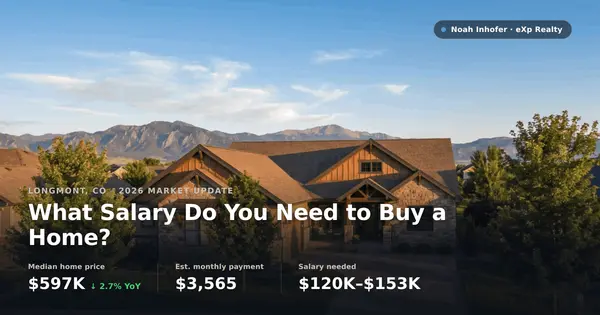
Wondering what it actually takes to buy here? I ran the income math: What Salary Do You Need to Buy a House in Longmont, CO in 2026?
What is a metro district, and why does it matter?
Ask this before you write an offer on new construction: "Is this home in a metro district?"
A metropolitan district is a special taxing district created to finance the roads, water lines, and parks that built a new subdivision, and it adds a line to your tax bill on top of the rates above. Many newer Northern Colorado neighborhoods sit inside one, and it can be meaningful money every month.
2 homes at the same price, one street apart, can carry very different tax bills. That gap does not show up in the listing price or in an online payment estimate.
It is not a dealbreaker, and it is not hidden. But you have to ask, because it will not be in the listing photos.
The 5 questions that actually separate these towns
- How far to where you will work, or fly out of?
- Is there a downtown you would actually walk to?
- New construction, or established trees?
- What does your money buy here versus 20 minutes north?
- And the one nobody asks: where would you meet people?
When should I start?
Most people who do this well start 6 to 9 months out.
The thing that turns a good move into a stressful one is almost never the house. It is the timing. You are trying to sell one house in Texas and buy one in Colorado, 800 miles apart, without owning both at once or owning neither. That is a sequencing problem, and it has to be solved before you fall in love with a listing.
Can I really buy a house from 800 miles away?
Yes, and most of my clients do exactly that.
A retired couple relocating from Georgia found my channel, interviewed several agents over Zoom, and hired me before they ever came out. They had bought plenty of homes in their life, so the process did not scare them. What they could not evaluate from 2 time zones away was the agent. That is the real problem with a long-distance move, and it is worth saying out loud.
They flew out one time for the inspection. I handled everything else: the MLS feed so they saw listings early, video tours on demand so they could pause and rewatch instead of relying on listing photos, and the negotiation. They closed $25,000 under list with several inspection items repaired before closing.
You are not choosing a house from 2 time zones away. You are choosing a person.
Get the guide
The full Texas to Colorado guide has the tax worksheet with the blanks laid out, the town cheat sheet including who each town is wrong for, and the timeline for 9 months out, 3 months out, and the month you land.
It is free, and it takes about 10 minutes to read.
Get the Texas to Colorado guide
Or if you would rather just talk it through, grab a time with me. No pitch. I answer the questions; you decide what to do with the answers.
You are not doing this alone.
Noah Inhofer · Colorado License #100088958 · eXp Realty
2319 Spencer St, Longmont, CO 80501
Equal Housing Opportunity
Recent Posts







"My job is to find and attract mastery-based agents to the office, protect the culture, and make sure everyone is happy! "