
Buying Acreage or Horse Property in Northern Colorado: What Nobody Tells You
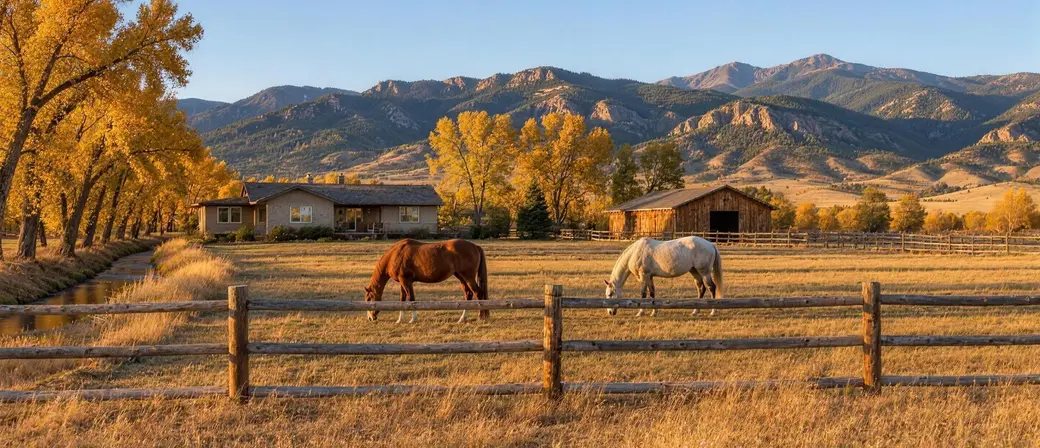
You can buy 5 acres in Northern Colorado, build the barn, put up the fence, bring your horses home, and then find out your well permit doesn't allow you to water them. That catches out of state buyers every year. I help people buy land and horse property from Longmont to Fort Collins and out into Weld County, and these are the 6 things I check before anyone writes an offer.
If you'd rather watch it, I filmed the whole thing.
Quick answer
Yes, you can buy horse property in Northern Colorado, but check 6 things before you write an offer. Most private wells drilled since 1972 on parcels under 35 acres are household use only, so they can't legally water livestock (Colorado State University Extension). Ditch water is owned as shares that can be sold separately from the land (CSU Extension). Larimer County caps total horses at 1 per half acre once you board any (Larimer County Land Use Code). And pleasure horses don't qualify land for an agricultural tax break (Colorado Court of Appeals, 1998).
The 6 checks at a glance
| Check | What to look for | Where to find it |
|---|---|---|
| The well | Household use only, or domestic and livestock? | The state well permit |
| The ditch | Do ditch shares come with the property? | The contract and the ditch company |
| The animals | How many, and what kind, are allowed? | County zoning and HOA covenants |
| The minerals | Who owns what's under the ground? | Title commitment and the state oil and gas map |
| The septic | Is the system working and permitted for the bedrooms? | A certified septic inspection |
| The taxes | Residential or agricultural classification? | The county assessor |
1. Your well permit decides whether you can water horses
In the city, water comes out of the tap and nobody thinks about it. Out here, a lot of acreage runs on a private well, and every well in Colorado comes with a permit from the state that spells out exactly what that water can be used for.
Most wells drilled since 1972 on parcels under 35 acres are permitted for household use only. That means inside the house. No lawn, no garden, and no watering livestock. So you can have 5 beautiful acres, a barn and a pasture, and a well that can't legally fill a water trough.
Flip it around: at 35 acres or more, you can usually get a domestic and livestock well. That permit can water your animals and up to 1 acre of lawn and garden.
That's why your neighbor might be watering horses and you can't. Their well might be older, their parcel might be bigger, or they might be on a different water source.
What to do: pull the well permit before you write an offer. It's public and it takes minutes. If the property is on a rural water tap instead, find out what that water district allows. The answer to "can I keep horses here" starts with the water, not the barn.
2. The ditch on the property usually isn't your water
A lot of acreage around Longmont, Berthoud and Loveland has an irrigation ditch running right through it, and it's easy to assume that water comes with the land. Usually it doesn't.
In Colorado, water rights are their own property. They can be bought and sold separately from the dirt they run across. Most ditch water is owned as shares in a ditch company. If a past owner sold those shares, you get to watch the water go by. You don't get to use it.
Here's the part people really don't expect: even if you own zero shares, the ditch company still has the right to come onto your land to maintain that ditch.
What to do: if water is part of why you want the property, name the exact shares in the contract, confirm them with the ditch company, and make sure they actually transfer to you at closing. If it's not written down, assume it's not included.
3. How many horses the county actually allows
How many animals you can have isn't up to you. It's up to the county, and a lot of the time the HOA. Northern Colorado sits in 3 counties, Boulder, Larimer and Weld, and they don't all play by the same rules.
In unincorporated Larimer County, for example, if you ever board a friend's horse, the total number of horses on the property can't go over 1 horse per half acre. So 5 acres does not mean 20 horses.
Don't assume acreage means no HOA, either. I've helped buyers into Berthoud Estates, where the lots run about 2 acres. It has a real country feel, and there's still an HOA with covenants you need to read before you sign.
One more Colorado rule that surprises people: Colorado is a fence out state. If your neighbor's cattle wander onto your land, you generally need a lawful fence in place to recover damages. Your fence isn't just keeping your horses in. It's protecting you.
What to do: before the offer, check the zoning, read the covenants, and make sure your plan fits. Horses, goats, chickens, a future barn. All of it.
If you're comparing a few properties and want a second set of eyes on the well permit and the covenants, call or text me at (720)741-7474. Checking those 2 things early saves a lot of wasted showings.
4. Who owns what's under the ground
In Colorado, owning the surface doesn't always mean you own what's underneath. It's called a split estate: someone else can own the mineral rights under your property. In Colorado, the mineral owner holds the stronger hand and is allowed reasonable access to get to those minerals.
This matters most in Weld County, and east of I-25 in general. This fall I had a buyer under contract on a home in Mead. She did her homework on the drilling activity around it and wasn't comfortable, so we terminated before the inspection and she moved on to a home that fit her.
New oil and gas well pads in Colorado have to sit 2,000 feet from homes, with some exceptions. But existing wells, pipelines and old plugged wells are already out there.
What to do: check the title commitment for severed minerals, and pull up the state's oil and gas map (the Energy and Carbon Management Commission's interactive map) to look at everything around the property: active, plugged and pending. It's free, it's public, and 10 minutes on that map can save you years of regret.
5. Septic: who makes the seller check it
Most acreage isn't on city sewer. Everything goes into a tank and a leach field out in the yard, and replacing that system is one of the biggest repair bills you can inherit.
In Larimer County, a septic inspection has been required before a home can sell since 2021. Not every county does that, so depending on where you buy, nobody may make the seller check it.
What to do: have the system pumped and inspected by a certified pro during your inspection period, every time. And make sure the permit matches the number of bedrooms. A 5 bedroom house on a 3 bedroom septic permit is a problem you don't want to inherit.
6. Ag zoning is not an ag tax break
This is the one almost everybody gets wrong. A lot of buyers see agricultural zoning and assume lower, agricultural property taxes. In Colorado, zoning and tax classification are 2 different things. The assessor looks at how the land is actually used.
To qualify, the land has to be run as a real farm or ranch, to make money, generally for the prior 2 years. Horses you keep to ride don't count: a Colorado court ruled back in 1998 that pleasure horses are not ranching use.
What to do: budget for residential taxes. If you're planning a real operation, like hay or cattle, talk to the county assessor and your CPA before you buy. I'm not your tax guy, but I'll make sure you ask the question before closing instead of after.
While you're thinking about the land itself: Colorado law requires every landowner to manage noxious weeds. On 5 acres that's real work, with mowing, spraying and a pasture plan. And in our dry climate, most small pastures won't carry horses on grass alone. Plan on buying hay.
What doing it right looks like: 36.98 acres in Nunn
Glenn and Brenda Petersen had owned a townhome in Longmont since 2008, and for years they told me they wanted land. Life kept getting in the way. We stayed in touch, and when the timing was finally right, we found a brand new build on 36.98 acres up in Nunn.
It first hit the market at $874,900. We closed at $799,000 in 24 days, nearly $76,000 under where it first listed, with every inspection item handled before closing. Glenn called it their forever home, and that's the whole point.
I've walked this same checklist on 2 acres in Berthoud Estates, on 12.88 acres outside Lyons, and on 36.98 acres in Nunn. Different land, same questions, every time.
Want the bigger picture on what moving here really costs? I covered it here: I Wish Someone Told Me These 5 Hidden Costs Before Moving to Northern Colorado.
Before you fall in love with a barn
Acreage is the best of Colorado: space, quiet, animals, and the mountains out the back door. It's also the property type where the things you can't see cost you the most.
Before you fall in love with a barn, let me check the water, the dirt and everything under it with you, step by step. Call or text me at (720)741-7474, or book a time with me.
Where this applies
These rules come up on acreage across Boulder, Larimer and Weld counties, from Hygiene and north Longmont to Berthoud, Lyons, Mead and Nunn. Each county runs its own zoning and septic rules, so the same 5 acres can come with very different answers a few miles apart. Rules here are current as of November 2026.
Questions this post answers
Can I water horses from my well in Colorado?
Only if your well permit allows it. Most private wells drilled since May 1972 on parcels under 35 acres are household use only, which means no outdoor watering and no livestock. Parcels of 35 acres or more can usually get a domestic and livestock well that waters animals and up to 1 acre of lawn and garden. (Colorado State University Extension)
Do water rights come with land in Colorado?
Not automatically. In Colorado, water rights are separate property and can be sold apart from the land, and most irrigation water is owned as shares in a ditch company. Buyers should confirm the exact shares with the ditch company and name them in the contract. (Colorado State University Extension)
How many horses can I keep per acre in Larimer County, Colorado?
If you board any horses, Larimer County's horse keeping rules cap the total on a lot, personal and boarded together, at 1 horse per half acre, so 5 acres does not mean 20 horses. Check the zoning and any HOA covenants too, which can be stricter. (Larimer County Land Use Code)
Do horses qualify my land for agricultural property tax in Colorado?
Usually not. Colorado taxes land by how it's actually used, not its zoning, and the Colorado Court of Appeals ruled in 1998 that grazing and boarding pleasure horses is not ranching use. Talk to the county assessor and a CPA before you buy. (Palmer v. Board of Equalization, Colorado Court of Appeals, 1998)
Is a septic inspection required to sell a home in Larimer County?
Yes. Since July 1, 2021, a property served by a septic system in Larimer County needs an inspection and a county Acceptance Document before the sale or transfer of title, with a few exceptions such as foreclosures. (Larimer County Department of Health and Environment)
About Noah Inhofer
I'm Noah Inhofer, a Colorado real estate broker with eXp Realty (Colorado License #100088958), based in Longmont. I've closed nearly 100 sales across Northern Colorado and beyond, on both the buying and selling side, from in-town homes to 36.98 acres in Nunn. Most of my buyers find me on YouTube while they're planning a move from out of state, and I built my out of state buyer program for exactly that: I film every home, you fly out once for the inspection, and I handle the rest.
I'm a licensed Colorado real estate broker, not a CPA, attorney or water engineer. Nothing here is tax, legal or financial advice. Sources: Colorado State University Extension; Colorado Division of Water Resources; Larimer County Land Use Code; Colorado fence law, C.R.S. 35-46-102; Colorado Energy and Carbon Management Commission, Rule 604; Larimer County Department of Health and Environment; Palmer v. Board of Equalization (Colo. App. 1998); Colorado Noxious Weed Act; IRES MLS, closed September 2026. Rules current as of November 2026.
Noah Inhofer · eXp Realty
9800 Pyramid Ct, Suite 400, Englewood, CO 80112
Equal Housing Opportunity
Recent Posts



"My job is to find and attract mastery-based agents to the office, protect the culture, and make sure everyone is happy! "